Showing posts with label In Today's News. Show all posts

Friday, September 22, 2017

In Today's News!

          Today in class we discussed the first people and their social structure. We talked about how our community is organized, and what some of the written and un written laws/practices are. Then we talked about how the community was organized.

          The first one we talked about was extended families (a family that includes in one household near relatives such as grandparents, aunts, or uncles in addition to a nuclear family) within a community. Communities were made up of many different kinds of extended families but the most occurring one includes; a child, grandparents, aunties and uncles, as well as cousins. 
          
          The next area we talked about was clans. A clan is considered as a group of people who make up a community or who exist inside of a larger community. A clan is mostly determined by common ancestry, like if you share the same ancestors, or geography so if you live in the same area. 
          
          Next was the community size. This is dependent upon the availability of resources to make sure that you have enough food, shelter, safety, etc. If you have a lot of resources within your community the bigger it is and the faster it will grow. The amount and availability of resources may rely on the seasons and climate of your area. An example of this is many Blackfoot nations lived in small clans in the winter but joined together as a large group to hunt bison in the summer. 
          
          The next factor that we talked about was gender roles. Women organized, prepared games, as well as planted and harvested crops. The men within the community hunted, defended the group, and negotiated relationships with other groups. Roles within the community were quite flexible, and everyone's contribution to helping the community was accepted, regardless of the traditions. 
          
          The next big factor within a community was elders. An elder is someone who is recognized for having a lot of knowledge and wisdom. An elder can be anyone, man or women, young or old, but they must have experience. They are leaders who teach through examples, and they are turned to lots for help and guidance and are respected greatly. 
          
          Next was education, in a community children learned by doing and were taught by their whole community. Everyone was expected to know their history, spiritual ideals, and all the practical skills.  The education within the first people was meant to guide children, not to intimidate them and control them. Everyone in the community was free to make their own choices as well as learn from their mistakes. The teachings themselves were holistic, meaning relating to or concerned with wholes or with complete systems rather than with the analysis of, treatment of, or dissection into parts. The mental, physical, emotional, and spiritual well being of the people was all being taken into consideration. 
         
         Lastly we discussed justice and conflicts, everyone within the group worked towards the good of the community. Everything was shared within the community, and by doing this it kept theft to a minimum. The people that broke the customs of the group were seen as un balanced, and were counseled by elders to make amends and restore the harmony within the group.


Refrences:


Definition of Holistic.(2017). Uploaded by Merriam-Webster, Incorporated. Website available online at  https://www.merriam-webster.com/dictionary/holistic


Definition of Extended Families.(2017). Uploaded by Merriam-Webster, Incorporated. Website available online at https://www.merriam-webster.com/dictionary/extended%20families


Tuesday, November 29, 2016

in the new of social struture

In todays news we are going to be talking about social structure and how some families are same and different. Some families are extended a extended family have the children grandparents aunts/uncles and their cousins and sometime mom and dad. There are also clans its a number of people who make up a community or who exist with in a bigger group. clans determined by:
the common ancestry( human animal)
history
depending on the group, you followed your mom (maternal) or dad (paternal) clan line. This leads to the community size for the community size it depended on the availability of resource's to ensure enough food and shelter and the safety if there is a lot of resource's then that means there are going to be more people. This could change during the season to for an example many Blackfoot nations lived in smaller clans in the winter. When the seasons get nicer they rejoin up again for hunting bison in the summer. The men and women have different roles and this will take us to the gender roles. The woman did the organizing, prepared games, planted harvest the crops. The men did the hunting and defending the group, negotiated relationship with the other groups. the roles were also flexible: everyone could to everything like men could do the organizing and the stuff that the girls did. the girls are the same way they could do the stuff that the guys did. It al deepened on the tradition.
now we are going to be going to the past witch are the elders they are recognized for having the most knowledge and the wisdom. to doesn't matter with it was male or female younger or older. They have the most experience they are the natural leader who teaches by example a lot of people in the community turn to these people on a daily bases. the elders are greatly respected. well now we are going to be talking about what everyone needs is an education the children learn by doing and were taught by the entire community. The whole community are expected to know their group's past, spiritual ideas and practical skills the education was meant to guide the children; not to tell them what to do. Everyone interprets things differently, makes their own choices and learn from their mistakes.
 http://www.clipartpanda.com/categories/extended-family-tree


Monday, November 28, 2016

the news of the pemmican prolamation and the pemmican wars

In today’s news we are going to be talking about the pemmican proclamation and the pemmican wars. In the pemmican proclamation the metis were the main suppliers of the pemmican for the NWC. It was also the main economic resource then the Selkirk settlers were still trying to adjusting the “NEW WORLD” that they were living in. They had really poor crops and food shortage to. Governor of the Selkirk colony Miles MacDonnell made an order that they were banning the export of any food from the red river valley this included the metis pemmican this really hurt the metis trade and the NWC traders to but this was order to design to ensure that the Selkirk settlers had food. This somewhat caused a war and this is how we got the Pemmican wars. The metis blamed the settlers that caused fighting between the two groups the fur trader's started to attack the pemmican stores for the metis. Everything like the equipment, horses and the crops were destroyed and the settlers were threatened in the end.


Thursday, October 27, 2016

war of 1812

 today in history class we learnt about the war of 1812. by reenacting the battles in class  Isaac brock was the leader of the defense of upper Canada. there was also Tecum seh he was the leader of the Shawnee people he allied with the British  in the war of 1812 there were many battles such as fort Detroit, queenston heights, York, Lundy's lane and the battle of Washington. the British won the battle of fort Detroit and queenston heights the Americans won the battle of York but the battle of Lundy's lane was uncertain who won because so many people died the battle of Washington was the last battle and the British one they signed a treaty call the treaty of Ghent in 1814 it ended the war between the British and American's  but they were still at war with the French. Veterans of the War of 1812.L. to r. - Col. Duggan, Rev. Geo. Ryerson, Wm. Roe, Jacob Snider, Dr. Jas. H. Richardson, Jos. Dennis, J. Woodall, Jas. ross, Col. Bridgford, Geo. Ridout. Photo taken Oct. 23rd, 1861. http://www.thecanadianencyclopedia.ca/en/article/war-of-1812/
Image result for the war of 1812

Friday, September 30, 2016

In Todays News, First Peoples Territories

   Before the Europeans discovered North America, Canada was thriving with thousands of different tribes of first nations. Not one group was the same, most had different dialects, worldviews, and ways of life. The Canadian encyclopedia describes the areas by saying "Rather than representing ten distinct cultures, these areas reflect geographic and cultural groupings that are fluid and often intermixed".  North America had ten of these regions in total, but only six of them were inside Canada's borders.
   The six different cultural areas in Canada included...
-Arctic
-Subarctic (Western and Eastern)
-Plateau
-Great Plains/Prairie
-Northwest coast
-Wood lands or Northeast
   Groups that lived in the same geographical areas would of had similar cultural elements, like diets, clothing styles, and housing. Below is a map showing these regions.
Cultural areas of North America Indigenous peoples at the time of European contact (2016) Uploaded by Nikater. Available online at: https://en.wikipedia.org/wiki/First_Nations#/media/File:Nordamerikanische_Kulturareale_en.png

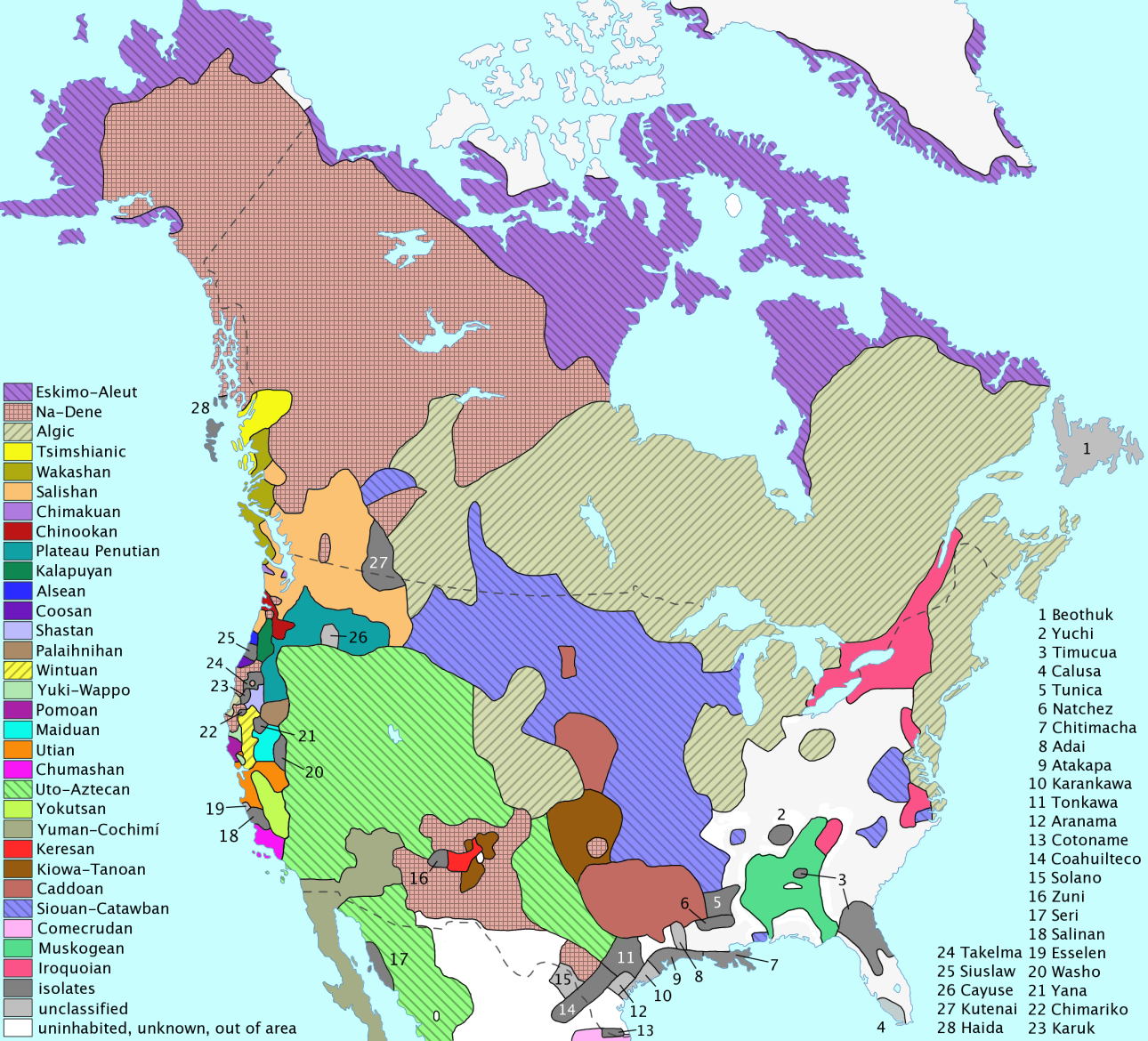
  During that time there were approximately 50 major language and 12 distinct language families in Canada, on top of that there were countless different dialects spoken by countless unique tribes. Language families are a group of languages that have evolved from one starting language. Although there were so many dialects, 94% of them are at risk of extinction. "As First Nations traditionally preserved and transmitted their culture and history through the oral tradition, no First Nations language in Canada had a writing system prior to European contact." (Quote from the University of British Colombia). It wasn't until the Europeans came over and taught them how did they start writing. Below is a map of the different language families. 
Distribution of language families and isolates north of Mexico at first contact (2016). Uploaded by  en:User:ish ishwar. Available online at: https://commons.wikimedia.org/wiki/File:Langs_N.Amer.png

For more visit.
http://www.thecanadianencyclopedia.ca/en/article/aboriginal-people/  (used for first quote)
http://indigenousfoundations.arts.ubc.ca/home/culture/languages.html   (used for second quote)
https://en.wikipedia.org/wiki/First_Nations

September.30, 2016


The First Peoples-Lifestyles


Today in our History class, we continued to learn about the first Peoples of Canada. We took notes on things like Justice and conflicts, Relationships, and Leaders.


Justice & Conflict
-everyone works towards the good of the community
-everybody shares their stuff with each other, so there wasn't nearly as much theft as there is now
-people who broke the customs were seen as "out of balance" (customs could be mental, spiritual, physical, or emotional)

-the people offended were consoled by elders to make amends and restore harmony
-the event of a serious crime (like murder) was considered a responsibility of the whole community(supervision, guidance, or isolation for a period of time)


Relationships
- All communities practiced self-governance
-most group decisions happened through consensus
-decisions needed to be for the good of everyone (in present + future/ humans, animals and nature)


Leaders
-decided in any ways depending on the group or family (family ties, abilities like hunting/ negotiating)
-Could change often depending on: >community confidence >season >community status (peaceful, in conflict, in crisis, etc...)


The First Peoples (2007). Uploaded by Goldi Productions Ltd.
Available online at: http://firstpeoplesofcanada.com/fp_groups/fp_groups_overview.html


 Historical Quotes Of The Day:
"Our greatest glory is not never falling, but in rising every time we fall" ~Confucius

"I like the dreams of the future better than the history of the past" ~Thomas Jefferson


Both quotes: History Quotes (2001-2016). Uploaded by unknown. Available online at: http://www.brainyquote.com/quotes/topics/topic_history.html


Thursday, September 29, 2016

In Today's News..

In the classroom we have been learning all about The First Peoples & Their world.

Territories

There are "6" Cultural Areas in Canada
-Arctic
-Subarctic
     -Western & Eastern
-Northwest Coast
-Plateau
-Great Plains/Prairies
-Woodlands
Map. (2012). Uploaded by Dragonfly Consulting Services Canada. Available online at:
http://dragonflycanada.ca/resources/aboriginal-peoples-terminology/


Language Families

Before the European Contact was made there were about:
        -50 major languages
        -12 distinct language families
        -numerous dialects.
To this day 94% of indigenous languages in Canada are at risk of extinction due to lack of speaking them. (1)The three most used are Cree, Ojibway, and Inuktitut
(1) https://slmc.uottawa.ca/?q=native_peoples_languages


Manitoba

We have three Cultural Areas in Canada:
      -Subarctic
           -(West/East)
      -Great Plains/Prairies
      -Woodlands
There are also language groups (5 of them)
       -Cree
       -Dakota
       -Ojibwe/Ojibway
       -Oji-Cree
       -Dene

(2) As of 2011, the most popular language spoken in Canada was Algonquian with a total of 144,015 people speaking it.
(2)https://www12.statcan.gc.ca/census-recensement/2011/as-sa/98-314-x/98-314-x2011003_3-eng.cfm


Social structure of the first people


During the class where we discussed the social structure and values of the first people we talked about gender roles, clans, extended families, community size and the elders. The social structures of the first people were usually based on the way a group related to one another based on written or unwritten laws.


The elders where the most respected people in the community or clan because of their wisdom and knowledge. People would go to the elders for advice and guidance. Elders could be a man or women and it did not matter if you were younger or old. To become an Elder you must have experience and you must earn the respect of the community through your wisdom and actions.


The clans were a group of individuals who make a community or are a part of a larger community. Clans were usually determined by common ancestry among the people. The size of the community was based on the amount of resources you have and that already exists in your location, the more resources you had the bigger your community or clan would become.


Extended families and gender roles: the extended families are made up of all the family members including: children, grandparents, aunts and uncles, cousins and your parents all in one house hold. the men of the house usually were the one who would take the role of hunter and they would protector the family and the villages. The men were also the one who went to war if one would ever happen. the women were the one who would remain in the village to tend to meals, harvest crops and organize the people. Children would also remain in the village and help with everyday duties like cooking, sewing, help in the fields.(uploaded by goldi productions in http://firstpeoplesofcanada.com/fp_groups/fp_wf6.html)


Leader; the leader or chief of the village was usually determined by the bloodline of the mother. the war chief was determined by position through valor, wealth and courage.  The more an individual had to offer and give away the more their status rose.
(uploaded by goldi productions in http://firstpeoplesofcanada.com/fp_groups/fp_wf6.html)


Monday, September 19, 2016

The First Peoples: Social Structure

 Today in Mrs. Thompson's class, we talk mostly about the lives and social structures of the First Peoples. We learned about the different aspects of how the First peoples lived.


Social Structure
-Extended Families
-Clans
-Community Size
-Gender Roles
-Elder
-Education (unfinished)


Extended Families


An extended family was made up of many relatives, like the children, grandparents, aunts/uncles, and cousins.
"Families were important, and extended families shared living quarters."
http://firstpeoplesofcanada.com/fp_groups/fp_wf6.html


Clans


A clan is a number of people that made up a society or lived within a bigger society. Common ancestry (human or animal) and geography were what determined clans. A clan can either follow the maternal(mother) side or paternal(father) side.
"Clan membership was always inherited through the mother's side of the family. A person always married outside of their own clan."
More information at:


First Peoples Historical Overview. Available online at:


Community Size
Depending on how much available resources there were determined the size of the community. Lots of food, safety, and shelter meant a big community. The community size also depended on the changing seasons.
"New villages were settled every 10 to 30 years. Every ten or twenty years – whenever the soil got poor, the place got too dirty, or the fish and game became scarce - everyone would move their village to a new place where the soil was richer in nutrients and the fish and game still plentiful."
Settlements and Housing . Available at: http://firstpeoplesofcanada.com/fp_groups/fp_wf2.html   

Gender Roles
Even though the roles of the women and men were pretty set, the roles were very flexible. In the end it didn't matter what gender you were as long as were contributing to the duties in the community.
"The females were symbols of fertility, and raised the children, and tended to the fields. The males were the hunters and the protectors of the family and the villages."

Elders
An Elder was someone who was very well respected, had great wisdom and knowledge. An Elder could be a person old or young, man or women, but the must have much experience in many different things. These people were who all the other people would come to for help regularly. They were not taught how to lead, so they were naturally like this.
"The Elders held the wisdom and were greatly respected. The eldest female was the master of the longhouse. The elder grandfathers were the storytellers."

Education
For education everyone in the community were the teachers, and the children learned by action. Their education system is based on guiding children to learn what they wanted. Everyone had different skills and so they learned by watching and practicing with other members who did that skill (hunters went hunting with long time hunters.) Although everyone in the community was meant to know the groups history, spiritualty, and basic skills.
"Children’s games, like those of the Sarcee, taught life skills."
 
                                            (Continuing more on Education next class) 


In Today's News..

Today In Mrs. Thompson's class, we leaned about the different cultural areas in Canada and the different Indigenous language families in Canada.

Cultural Areas
There are "6" Cultural Areas.
-Arctic
-Subarctic
  -Western and Eastern
-Northwest Coast
-Plateau
-Great Plains/Prairie
-Woodlands

Cultural groups were separated this way because of (1) “groups that are or were similar in culture and history,” For example they had the same style of clothes, houses and food sources.
Aboriginal Cultures Groups Map. (2011). Uploaded by O, Canada!. Available online at: https://1eonsauce.files.wordpress.com/2011/03/aboriginal-culture-groups-map-best.png


(1) http://www.thecanadianencyclopedia.ca/en/article/aboriginal-people/


Language Families

Prior to the first European contact (2) (France in 1534) there were approximately 50 major languages. They were 12 distinct language families but countless dialects.
Language is arguably the most important part of the First People's culture and history.
Roughly 94% of Indigenous languages are at risk of extinction.


(2) https://en.wikipedia.org/wiki/New_France


Manitoba

Manitoba is a part of 3 Cultural Areas.
 -Subarctic (East & West)
 -Great Plains
 -Woodlands
Manitoba is also a part of 5 language families.
 -Cree
 -Dakota
 -Ojibway
 -Oji-Cree
 -Dene

Wednesday, September 14, 2016

WHO CARES?

In class, we learned to rate exactly how historically significant events from the past were.


"Historical significance is the process used to evaluate what was significant about selected events, people, and developments in the past. Historians use different sets of criteria to help them make judgements about significance." http://facingthepastshapingthefuture.com/teacher-guidance/teaching-learning-strategies/history/historical-significance/


Every event ranges in significance and its historian's jobs to determine that. They have to determine whether or not an event is worth sharing with others. Historians have to think about many things when they determine historical significance and weigh the overall importance of an event.


Historical significance depends on many things.....
         
Importance of event at the time
          How widespread and lasting were the consequences of event
          How much the event/incident symbolized an important issue or trend
          Which group deems it important... it usually isn't important to everyone

All these aspects of historical significance deem things important but it is crucial to recognize when events aren't important enough to share with a nation. Not everything needs to be remembered, but some things certainly do in order to not repeat history. The things that need to be remembered are considered historically significant. Not all historically significant events are well known and it's our job as a human being to recognize it and do our best to share it with the world, but sometimes we remember things we really don't need to. After all, eating a really good pb&j sandwich might be important to you at the time, but I don't think the council of world leaders would really care. Meanwhile, everyone wants know if there's a new leader because it could initiate all of the things that make an event important... especially if there's a leader as attractive as Justin Trudeau.
"Very simply put. Something of historical significance is anything that had a bearing on the situation at the period of time it took place. For example, gun powder being used in a cannon for the first time changed history. so its significance was real. Another example was at the battle of Hastings 1066 the English cavalry could not use their lances at full speed as they had no way of staying on the horse when contacting the enemy. The reason..Their didnt have stirrups to help support them in the saddle. The Normans did have them. They were invented by the Mongols and slowly spread across Europe. So stirrups were of historical significance at Hasting..They helped win the battle." -Howard Prothero

Sunday, August 07, 2016

EXAMPLE POST - In Today's News

     Today Mrs. Thompson shared that our class will be co-authoring a collaborative blog as part of our Canadian History class. This blog will be where we, as students, can demonstrate how well we understand the material being covered in class. Each student in the classroom will be blogging once per month as well as commenting on one of our friend's posts twice per month; these will be assessed by Mrs. Thompson using rubrics provided to us in our Blogging 101 packages (see tab at the top of the blog for more information).

     There are six different blogging prompts that are provided to help develop our posts; this one models the blogging prompt, "In Today's News". This type of post should, "Summarize what was discussed in today's class; your post must include enough information so that if someone was absent they would fully understand what went on."(1) One of the challenging aspects of this type of post is that, "Your post cannot include the notes provided in class, it must be in your own words."(2) One requirement of this type of post is that we find applicable quotes about the topic of the day, the explanation of these quotes can help expand the detail of our post and ensure that our post is not simply a re-telling of any notes that were provided in class.

     To ensure that our post includes all of the information required by Mrs. Thompson, we can use the following rubric:

In Today's News Rubric. (2016). Uploaded to Canadian History Told By Us by Kirsten Thompson. Available online at: https://canadianhistorytoldbyus.blogspot.ca/p/blogging-package.html


(1) Blogging Package: In Today's News. (2015). Uploaded by Kirsten Thompson, pg 10. Available online at: https://canadianhistorytoldbyus.blogspot.ca/p/blogging-package.html
(2) Blogging Package: In Today's News. (2015). Uploaded by Kirsten Thompson, pg 10. Available online at: https://canadianhistorytoldbyus.blogspot.ca/p/blogging-package.html